
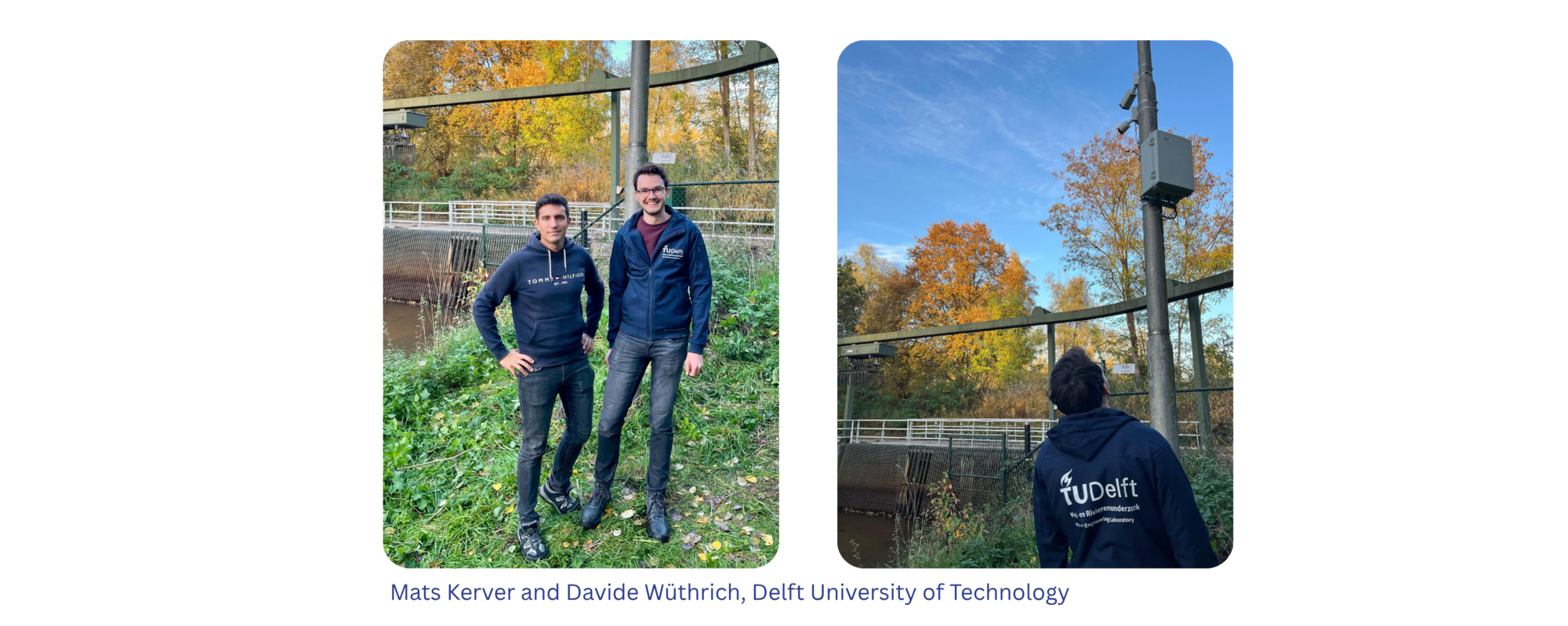
We spoke to Mats Kerver, a PhD researcher at Delft University of Technology, whose research contributes to the JCAR ATRACE programme. His work focuses on how floating debris is transported through rivers and accumulates at bridges and other hydraulic structures during flood events. In this interview, he explains how debris can intensify flooding, threaten critical infrastructure, and why better monitoring and modelling are essential for more resilient flood risk management.
Can you briefly describe the main topic of your PhD research?
My research focusses on monitoring, classification and quantification of (floating) debris transport and accumulation in waterways. This debris can be natural (plants and trees) or anthropogenic in nature (plastics, rubble). Previous floods showed that debris can accumulate at hydraulic structures, causing clogging in the waterway and reduce capacity. When this happens, a strong increase in upstream water level can be observed, leading to exacerbated flooding. Besides the water levels, bridges can also collapse due to the additional forces on the structures induced by debris buildup. This was also seen in the July 2021 floods in Germany, Belgium and The Netherlands.
What motivated you to pursue a PhD, and why in this field of research?
For as long as I can remember, my favourite word has been:
Why?
Throughout my life, I have bothered my family, friends, and colleagues with this question. I’m always keen to understand how something works, and I will not stop asking why until I completely understand. While some would consider this trait somewhat bothersome, it has been the driving force behind all my academic progress. After studying mechanical engineering for my bachelor, I submerged myself in the field of fluid mechanics, which I have loved ever since. Besides learning, I have also always loved teaching and have done so throughout my life. I have now taught all the way from children of the age of 6 up to bachelor students in civil engineering. By doing the PhD, I can expand further and teach master students the fundamentals of managing their own research projects.
When choosing this field of research, two main aspects drew me in:
- The fact that the problem, while complex, is also quite straightforward for others to understand. The idea of a water conveying structure getting clogged and causing problems is relatable for a lot of people, making them more interested in the topic.
- The fact that so little is known about this problem. We have observed various episodic events where debris had a large influence on flooding, but currently the understanding of when and where this happens is lacking. With our monitoring campaigns we assist in incorporating debris into the current hazard models, making governments and residents more informed and better prepared for extremes.
Does your research focus on a specific geographic area?
My research focusses mostly on the areas affected by the July 2021 floods in Germany, Belgium and The Netherlands, but can in principle be applied to any catchment with similar characteristics. The monitoring I am conducting takes place along the Geul, Meuse and Ourthe, as well as smaller tributaries of these rivers. During large precipitation events in the coming years, we are planning to deploy flexible monitoring stations as well, to capture a large variety of debris regimes (types, transport properties and transported volumes).
What specific objectives are you aiming to achieve with your current research?
The objectives for this research are threefold:
- To understand hydrological and hydraulic processes governing debris transport.
- To obtain detailed insights in the hydrodynamic processes that govern debris carpet formation (the accretion of debris) and its consequences (increased flooding and damaged structures)
- To incorporate the modelling of these transport and accumulation processes in flood risk management strategies.
How does your work fit within the JCAR ATRACE programme and its goals?
To be prepared for extreme climate events, we need to incorporate the effects of debris accumulation, as this has a strong influence on the extent and severity of flooding. Furthermore, damage to bridges and other infrastructure has an impact on emergency response capabilities during flooding, and as such also needs to be considered. Other PhD researchers within the JCAR ATRACE programme point out the need to incorporate debris in hydrodynamic models, which is a great starting point for further collaboration.
Regarding transboundary collaboration, I’m partnering with institutions and companies in both The Netherlands, Belgium and Germany to assess debris management across the transboundary catchments selected within the JCAR ATRACE scope. Besides this, most of the considered catchments (i.e. Geul) are transboundary, with debris originating in multiple countries.
Which opportunities and challenges do you envision conducting your research in a transboundary context?
By looking at the issue of debris transport in a holistic way, a more fundamental understanding of the processes driving debris transport will be obtained. By looking at transboundary catchments, we can also identify societal drivers of this transport in different countries, rather than only considering natural processes. This is important because a significant fraction of floating debris during floods is of human origin, like for instance plastics or cars. Challenges can arise where debris needs to be managed, either by recycling or periodic removal, as this requires committing (financial) resources. Depending on where debris originates and what stakeholder needs to commit resources to clean it, challenges can arise. Here, my research can also inform decision making and potentially realize savings by managing debris in a more deliberate way. Governments and companies are showing interest in this topic, and it is important to explore these opportunities during my research.
How does your research fit within the partnerships between regional governments and academic institutions?
Preparing for floods is a collaborative process, and my research aims to incorporate the effects of floating debris in flood risk assessment. (Regional) Governments have a large interest in this problem since debris accumulation is still poorly understood. In collaboration with local partners, we can identify locations vulnerable to exacerbated flooding due to debris and take the first steps to address these vulnerabilities. I think all the young researchers in this project are uniquely well positioned to make the connection between academic institutions and governments, both during their current research projects and after.
In which ways do you see your research having an impact on policymaking?
The research of debris transport is still in the early stages, and when debris-related challenges with debris are mentioned, no concrete design requirements are available. With this research, we want to assist policy makers in making informed choices when developing effective debris- management strategies. Besides this, informing regional governments which structures are prone to additional flooding due to debris accumulation can help preventing damage. Some water authorities already have certain requirements on structures placed in waterways to prevent clogging, but this can be made more concrete based on the findings of my research.
Given the wide variety of stakeholders involved in JCAR ATRACE, what interactions do you look forward to?
Debris accumulation is relevant at both local and regional scales. One of the strengths of JCAR ATRACE is that it enables interaction with stakeholders on different scales. Currently, I’m gaining valuable knowledge from local stakeholders that have long-term experience with the frequency and severity of clogged structures in their respective waterways. I am also looking forward to leaning on the advanced knowledge of my peers from the other research partners and sparring on our respective research challenges.
What long-term impacts do you envision your research having on regional climate strategies?
Long-term, we want to ensure that debris does not get trapped at critical flow conveyance structures and that their performance is not affected. My research can inform where debris is coming from and in what volumes, allowing the development of management strategies for these expected volumes. This can be achieved by periodically clearing the structure itself, reducing the presence of debris in the floodplain or by removing the debris before the structure. This can be done using debris racks, that are designed to trap debris before they affect the discharge capacity of structures. If the expected volumes and return periods are known, debris (accumulation) can be included in flood risk management strategies.
Which scientific or technological breakthroughs do you hope to encounter during your PhD?
Our current understanding of debris transport and accumulation is very limited. We have observed some extreme cases but currently do not have any model for predicting the mobilizing volumes for a given condition. With my research I hope to demonstrate the hydrological and hydraulic patterns that govern this transport. For instance, showing how debris transport varies between seasons or for different precipitation events. With that knowledge, we can start to design structures that consider the issue of debris, vital for dealing with the extremes in our changing climate.
What are some challenges you anticipate facing as climate conditions continue to change? And how do you see your research adapting to these evolving challenges?
Debris transport is both continuous and episodic, and with a strong memory effect. This means that if there are two flood waves in a row, the second one likely carries far less debris volume, as this has already been transported downstream. If there are longer and more extreme droughts due to climate change, this also means that debris has more time to collect in the floodplain. Then, when there is an extreme precipitation event, it could mobilise all at once, accumulating in larger volumes than before. My research tries to incorporate these memory effects to also account for these extremes in a changing climate.


