
On 9 September, I had the opportunity to attend the 12th edition of the International Meuse Symposium in Liège. The event brought together academics, regional authorities and water management practitioners involved in the Meuse basin and neighbouring river basins to exchange knowledge and discuss emerging challenges in water management. JCAR ATRACE was represented through a poster presentation on stress testing in the Rur catchment, while several colleagues also contributed through their participation in the audience and the organisation of the symposium.
The International Meuse Symposium serves as a forum for exchange among researchers, water managers and stakeholders working in the Meuse basin. Established as a follow up to the AMICE project, the symposium aims to promote the sharing of knowledge and experiences on topics such as transboundary water management, hydrological modelling, and issues related to water quantity and quality. The event is jointly organised by Deltares, the University of Liège and Schone Maaswaterketen.
A Strong Focus on Drought and Low Flows
Given the hot and dry summer experienced across the region, it was no surprise that drought and low flows featured prominently in the opening session. Three speakers approached the topic from different perspectives and highlighted the complexity of managing water resources under changing climatic conditions.
Prof. Dr. Michelle van Vliet from Utrecht University presented a global perspective on droughts. One of the key messages was that drought affects not only water quantity, but also water quality. The presentation highlighted the need for sustainable water management solutions that acknowledge trade-offs between different societal goals, including access to clean water and the transition to clean energy.
Prof. Dr.-Ing. Holger Schüttrumpf of RWTH Aachen University discussed the role that large dams can play in mitigating drought impacts. He also raised an interesting question about the potential for cooperation between catchments and whether water transfers between regions could become part of future drought management strategies.
The third contribution, delivered by Deborah Dotta Correa, took a more interactive approach. Participants were invited to reflect on a fundamental question: should human activities adapt to environmental changes, or should we adapt the environment to continue supporting our activities? The session also illustrated how the areas that contribute water to maintain river flows can change significantly during dry periods compared to normal conditions.
Floods and droughts pose significant challenges for stakeholders in transnational river basins, highlighting the need for cooperation at the catchment scale and a more holistic approach to water management. Last summer showed us both the challenges associated with low precipitation and the benefits of effective water management in the Meuse. In this context, analysing how different areas within a transnational catchment contribute to drought conditions could help identify the most vulnerable areas and better target measures, while promoting more coordinated and effective action across national borders.
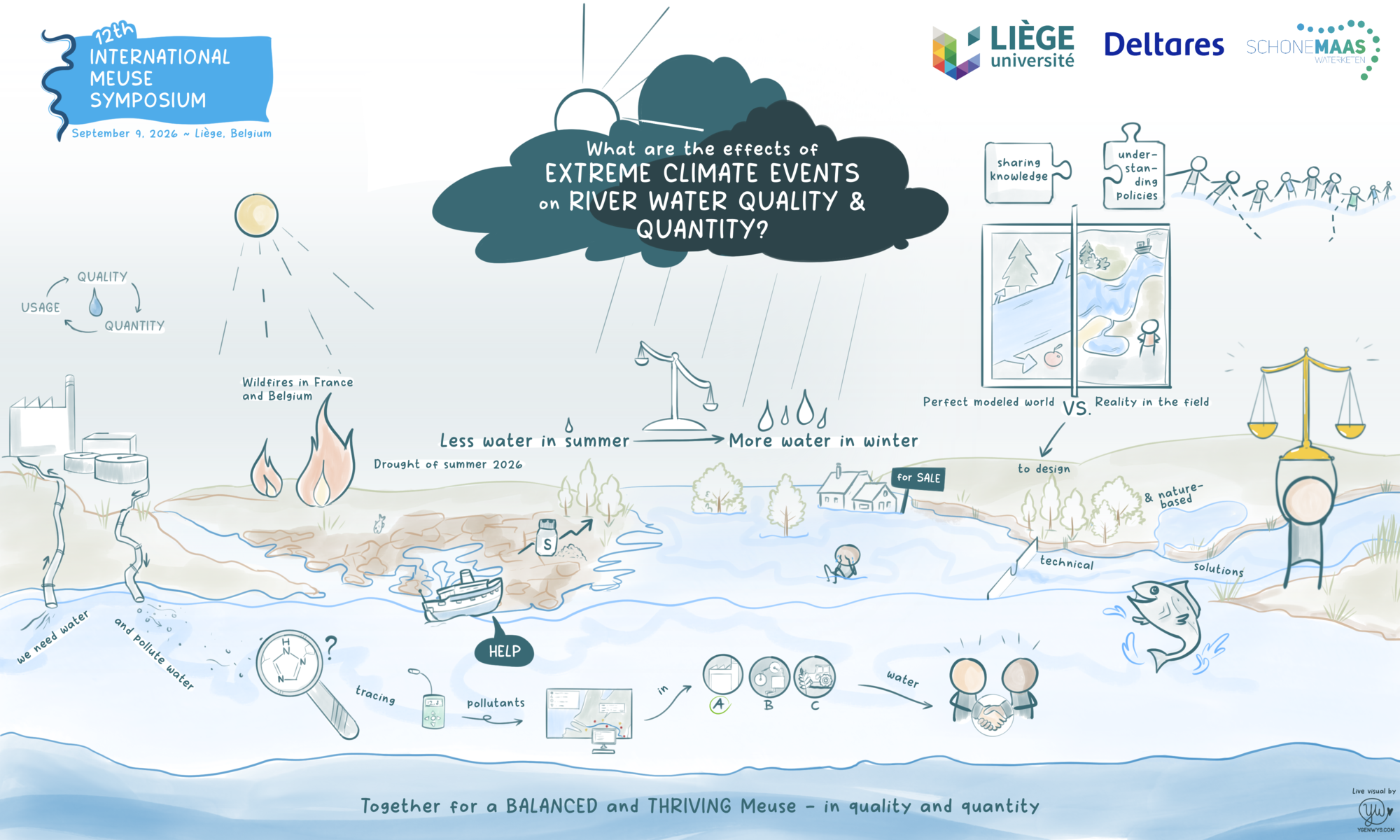
Water Quantity and Water Quality Challenges
Following the opening session, the symposium continued with two parallel tracks. One focused on water quantity and covered topics such as floods, low flows, climate change and fish migration. The second focused on water quality, with presentations addressing pollutant detection, modelling techniques, prediction methods and governance approaches.
What stood out to me was the breadth of research currently taking place across the Meuse basin. Despite the diversity of topics, a common thread ran through many of the presentations: water managers are increasingly being asked to deal with extremes, whether that means too much water during floods or too little during droughts. Climate change continues to intensify these challenges and reinforces the importance of collaboration across disciplines and regions.
The Meuse Symposium brought up the topic of Nature-Based Solutions, with the exploration of their effectiveness showing that there is no single, one-size-fits-all measure. It is common to hear that they can help not only deal with floods but also address other events expected to increase due to climate change, such as heatwaves. However, these measures still require more validation data.
Interestingly, differences in benchmarking approaches across countries were highlighted, along with the lack of a general framework to monetize non-monetary effects. This emphasized the need to strengthen the exchange of best practices and lessons learned from already implemented NBS projects. Such knowledge-sharing could improve our understanding of their performance, support the development of more generalizable assessment frameworks, and facilitate the implementation of future measures.
Relevance for JCAR ATRACE
Many of the themes discussed throughout the day closely align with the work being carried out within JCAR ATRACE. Discussions on drought resilience, climate adaptation, flood risk management and cooperation across river basins all resonated strongly with current research activities within the programme.
The symposium also provided a valuable opportunity to exchange ideas with researchers and practitioners working on similar challenges. For instance, last year, I had the opportunity to present my work on flood damage modelling in the commercial sector, which allowed me to connect with experts working on similar topics in different regions. Having this event take place annually also helps maintain these exchanges and build on previous discussions. This year, JCAR-ATRACE was represented through a poster on stress testing in the Rur catchment, providing another opportunity to exchange ideas, learn from ongoing initiatives, and gain new perspectives that could inform future research and potential collaborations.
Looking Ahead
One of the main messages I took away from the symposium was that water management involves balancing different, and sometimes competing, needs. Measures designed to address droughts, floods or water quality issues can have wider implications for ecosystems, energy production and other water users. I would therefore be interested in exploring further how these trade-offs can be assessed and how decision-makers can identify solutions that provide benefits across different sectors.
The Meuse Symposium create valuable opportunities to connect research, policy and practice, while encouraging discussions on how to prepare for increasingly complex water management challenges. The discussions and exchanges provided plenty of inspiration for future collaboration and for upcoming events, including the next Rhine Symposium. As droughts, floods and other climate related challenges continue to affect river basins across Europe, platforms that bring together different perspectives will remain essential.


