
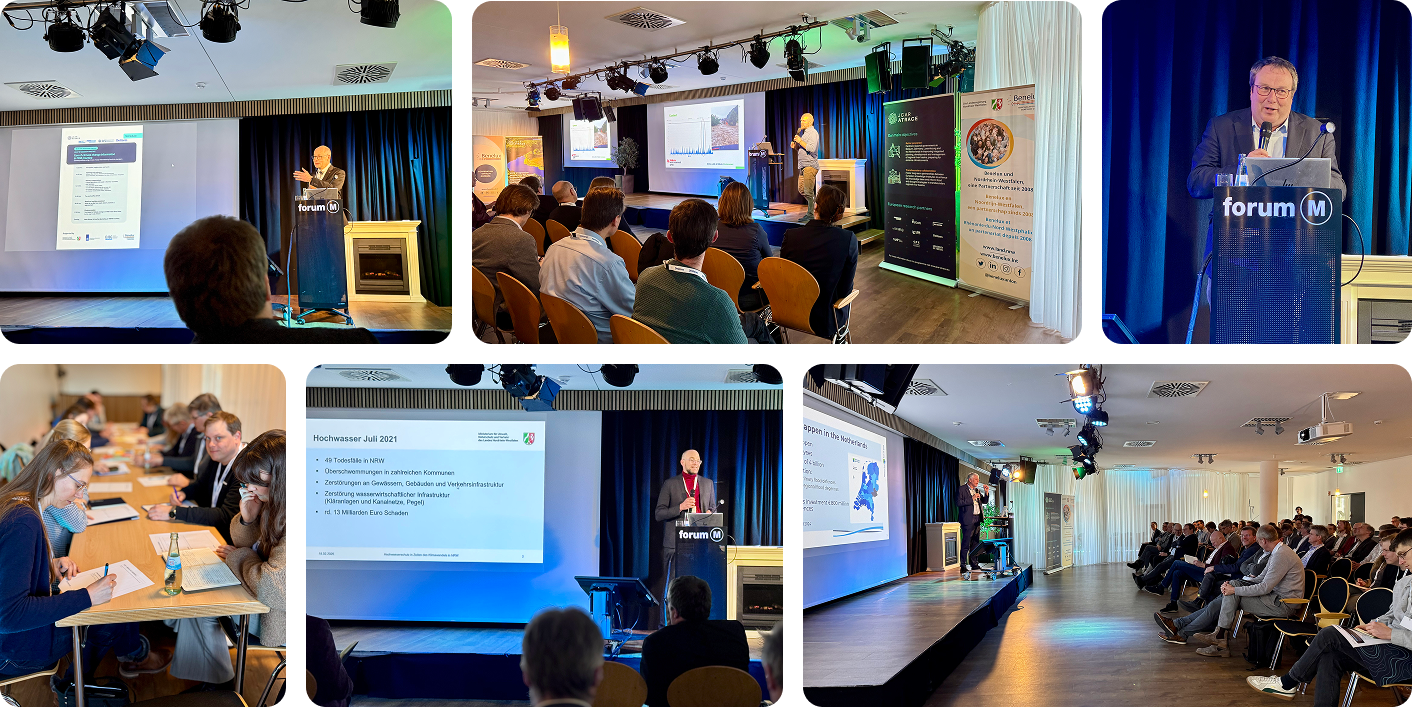
On 18 and 19 February 2026, more than seventy practitioners, policymakers and researchers from Belgium, the Netherlands, Luxembourg and Germany gathered at Forum M in Aachen. Invited to the ‘heimat’ of our partner IWW RWTH Aachen, the two-day workshop brought together the international JCAR ATRACE community, united by the shared objective of strengthening preparedness for future climate driven flood extremes.
Understanding future climate impacts on flood risk
The purpose of the workshop was to explore how climate change information is currently used in flood risk management practice and what additional knowledge practitioners need going forward. Informed by the recently published joint inventory overview developed by JCAR ATRACE, lead by our partner GFZ Potsdam, the programme focused on exchanging national and regional experiences, intensively discussing commonalities and differences across the regions, and discussing how scientific insights can better support practice.
Participants were invited from ministries, national and regional water authorities, river basin organisations and scientific institutes from the Benelux countries and Germany. The agenda combined keynote presentations with structured breakout sessions, supporting an in-depth dialogue on current practices, future challenges and opportunities for improved cross border cooperation.
Opening and key themes
The workshop opened with a welcome address by Mr. Oliver Krischer, Minister for the Environment, Nature Protection and Transport of North Rhine Westphalia, who emphasised the need to prepare for future unprecedented floods and the value of collaboration among neighbouring regions. Plenary contributions from leading practitioners highlighted national and regional approaches to integrating climate information into flood risk management practice and policies, followed by discussions on the scientific state of the art in climate projections, hydrological and societal impacts and uncertainty handling.
Breakout groups explored two central questions:
- Which elements of each country’s approach could be valuable for others
- What scientific information is most relevant for improving preparedness for future flood extremes
These exchanges provided clarity on where progress is already being made and where further alignment and knowledge development are needed.
Looking ahead
Following these reflections, the workshop continued with discussions on how scientific findings can be more effectively translated into operational decision making and how the JCAR ATRACE network can strengthen cross border learning and collaboration. The sessions underscored a shared determination to improve climate resilience through coordinated action.
A summarising report, including presentations and proposed follow up actions, will be published soon on the JCAR ATRACE website and through external channels.
We extend our appreciation to the organising JCAR ATRACE partners – IWW RWTH Aachen, GFZ Potsdam and Deltares and the many committed supporting government organisations whose engagement and ongoing commitment made the research and this workshop possible, including the Ministry of the Environment, Nature Conservation and Transport of North Rhine Westphalia, the Ministry of Infrastructure and Water Management (NL), the Benelux Union, the German Hydrological Society, and the presenters from authorities such as Waterschap Rijn en IJssel, Service Public de Wallonie, Vlaamse Milieumaatschappij, KU Leuven, and Université de Liège. We also thank Jana Vredenburg from FiW Aachen for excellent moderation and all other participants for sharing their insights and for their open and constructive contributions.
The JCAR ATRACE community continues to grow and remains committed to deepening cross border collaboration and jointly developing knowledge to strengthen preparedness for future climate extremes.


